Showing posts with label Real Horse Shows. Show all posts

Saturday, August 20, 2011

Western Horsemanship

Horsemanship is a lot like Equitation. The difference is Equitation is always associated with english riding, and Horsemanship is the western version.

Horsemanship and Equation are like the riding version of Showmanship. The majority of the class is judged on the rider, but also how the horse responds to the rider. "Judging focuses on the rider’s body position, seat in the saddle and ability to control the horse."

Just like Equitation and Showmanship, horses enter the arena and line up tails to the rail. One at a time they step up to the first cone, wait for the judge to nod, then start their pattern. As always, they always look back at the judge been the pattern is finished and look for the nod again.

I never mentioned this before, but most classes (not only patterned ones, but pleasure classes, jumping classes, etc.) are often divided up into categories. Sometimes they are divided up into age groups (for instance, dressage is divided into Young Riders which is 21 and younger, Adult Amateur which is over 21 and Open). A majority of open shows are also divided by Walk/Trot and Walk/Trot/Canter.

At this show, there was a class for only Walk/Trot and Walk/Trot/Canter. Since one class included canter and the other didn't, there were two different patterns for the horsemanship class.


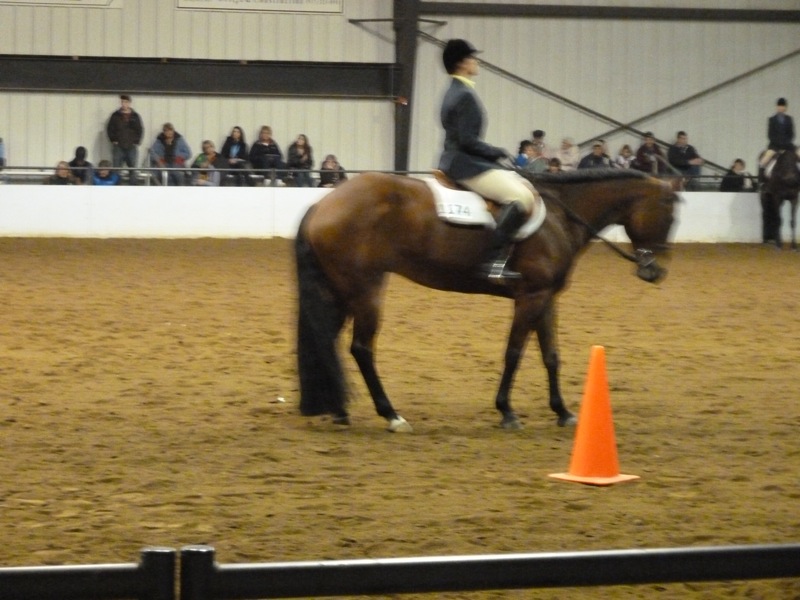
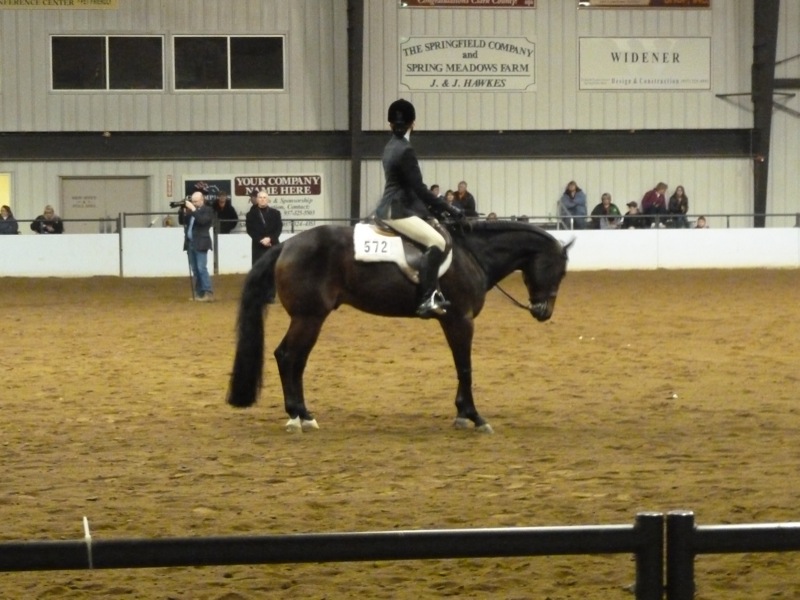
Since I went through all the steps with Equiation and Showmanship, I am going to skip over the individual parts of the pattern. Here are a few pictures form both of the patterns combined.


As you can see, Horsemanship follows the same general trends as Western Pleasure.

Here is a video of the walk/trot pattern.


Notice the rider's equitation (meaning, what she looks like in the saddle). She is sitting up straight, with her shoulders back, her back arched, her heels down, and her eyes up. Overall, she has a good position. Just as important, notice what very little she does to cue the horse and he responds decently well. These are the things that are important in Equitation and Horsemanship classes.

Also, here is a few examples of the walk/trot/canter pattern.

Again, the girl's have good position and the horses respond to very minimal cues.

Those are the basics for a Horsemanship class!

Questions? Just comment or e-mail labelle012@yahoo.com

Thursday, June 9, 2011

English Equitation

Remember when I went to a horse show at the beginning of the year? I have a few more posts that go along with it! This post has been a long time in the making, but here it is (finally!):

English Equitation is a common class at many horse shows. It isn't seen too much in the model world, but it would be a very easy to setup! Here is the stock type version that is used at most open shows.

From the AQHA rulebook, Equitation is described as follows:

“Hunt seat equitation on the flat is an evaluation based on the ability of a rider to perform various maneuvers in harmony with his/her horse. The communication between horse and rider through subtle cues and aids should not be obvious. Equitation is judged on the rider and his/her effect on the horse. Hunt seat equitation on the flat provides a base for a natural progression to over fence classes. The poll should be level with, or slightly above the withers, to allow proper impulsion behind. The head should not be carried behind the vertical, giving the appearance of intimidation, or be excessively nosed out, giving a resistant appearance.”

Considering Equitation classes are waited heavely on the rider, it is crucial to have a doll in your set up! But other than that, all you need is a few cones and possibly a judge! Along with some english tack and a horse, of course!

To begin with, every Equitation class has a pattern. Like showmanship, the pattern is posted ahead of time to give the exhibitors a chance to memorize it. The one from the show looked like this:


To start the class, riders line their horses up ‘tails to the rail’. In a way, equitation is very similar to showmanship. Once everyone is in the arena and ready to go, the judge nods to signal the first rider to start the pattern. Then the rider waiting at the cone can start their pattern.

For this pattern, the rider started by sitting the trot from cone A to cone B.


Then at cone B, the horse should pick up the lead lead and canter a circle.


Once the circle is complete, the horse should drop to a trot and the rider should post on the right diagonal.


Next, halt at cone C and back up.


After the rein back, the rider looks at the judge, who then dismisses her with a nod.


Once all the patterns are complete, the rest of the class is treated like normal english pleasure. Everyone walks, trots, and canters on the rail. They may only go one direction or both.


Here is a video of a few of the better patterns:


Patterns may vary greatly from show to show. This is a very common type of pattern, usually used at open shows. At higher levels, patterns might include leg yeilds, flying changes, serpentines, etc.

If you have any questions, feel free to ask!

Tuesday, March 1, 2011

Showmanship - Trends

Here are some extra photos from the show that I found interesting.

All types of horses (and people!) were showing in showmanship.

Some horses were big


and some were small.


Some handlers were male.


Some were very young! (and cute :))


Most showed in fancy halters, but some were plain.


Some horses had braided manes (see above), some were long


but, most were short and banded.


Here are some cool colors:


And my favorite horse at the show: Sonny's look-a-like!